
Let’s talk about sex.
It’s no surprise that sexual education around the world often leaves much to be desired. However, in developed countries like the United States that value the funding of education and healthcare above many other things, the expectation is that sexual education would be at least adequate. I hate to break it to you, but it’s not.
In the state of Virginia, where I live, all public schools have the choice to follow the Code of Virginia for Family Life Education, which suggests appropriate topics for students from kindergarten to senior year of high school. However, each one of these schools has the power to remove sexual education from their health curriculum, and in fact, there are a number which choose to do so.
However, the majority of institutions do include some form of sexual education. Yet, these schools that do choose to teach sexual education have a surprising amount of freedom in terms of content, if you really look into the Code. For example,did you know that it was just recently permitted to teach consent? Or that ‘‘abstinence education’’ is the first guideline listed in the entire 60 page document? It doesn’t doesn’t stop there; if you keep reading, “abstinence education” appears 9 more times and “marriage” appears 22 times.
If a public school decides to follow the Code, they are also required to create a school health advisory board. It is mandatory that one member of the board is some sort of health professional (it could be your optometrist, couldn’t it?), which sounds rational, until you realize that only one medical professional is required whereas the requirement for a clergyman is at least one. It seems as if the former requirement is made begrudgingly while the latter is encouraged. Is it more reasonable for a member of the church or for a medical professional to decide sexual education curriculum? Under current guidelines, this decision is left up to each county.
The effects of the non-compulsory and indirect nature of the Code are being felt in many regions of Virginia.
In 2011, NBC12 wrote an article in which Catherine Comer, a teen mother from Thomas Dale High School, was interviewed about her experience with sexual education in Virginia public schools. She felt that neither her school nor her parents provided her enough information about sexual relationships and claimed that, “…they teach abstinence but that’s it, and that’s not the reality”. One common argument for not providing comprehensive sexual education is that such topics should left to parents to discuss with their children. However, if this line of reasoning is applied to other aspects of education, problems arise fairly quickly. There’s a reason economics and personal finance is a required high school credit; it is significant to a young person’s ability to function in the real world, and it wouldn’t be required if parents were adequately teaching their kids how to fill out a W-2 form. Why should sexual education be any different? Instead of trying to stifle the natural curiosity teenagers (which hasn’t worked well thus far), the goal should be to teach teens how to safely interact with one another and to provide scientifically accurate educational alternatives to courses that are focused primarily on abstinence.
Teen pregnancy rates across Virginia, per 1,000 teens (ages 10-19), in 2013, are shown below. It should be noted that the only statistics that the Virginia Department of Health provides are from 2013. The results for the 2013 Gubernatorial Election are also present, to provide a sense of the distribution of political ideology in Virginia at the time.
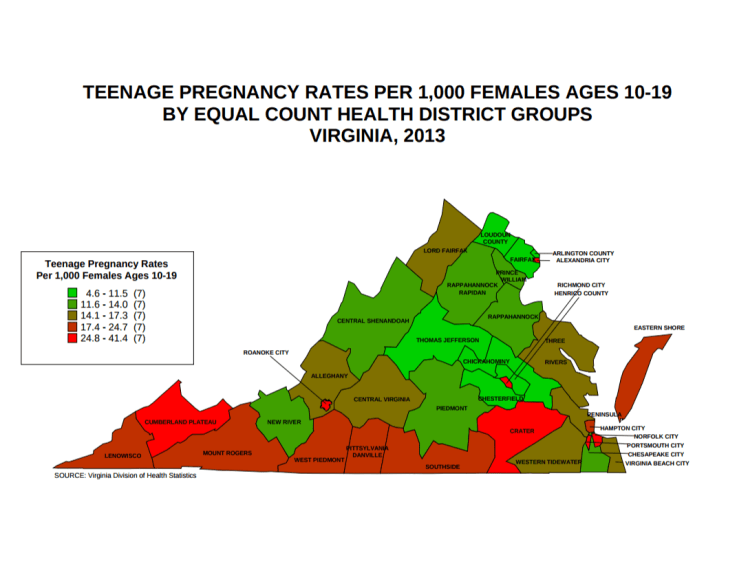
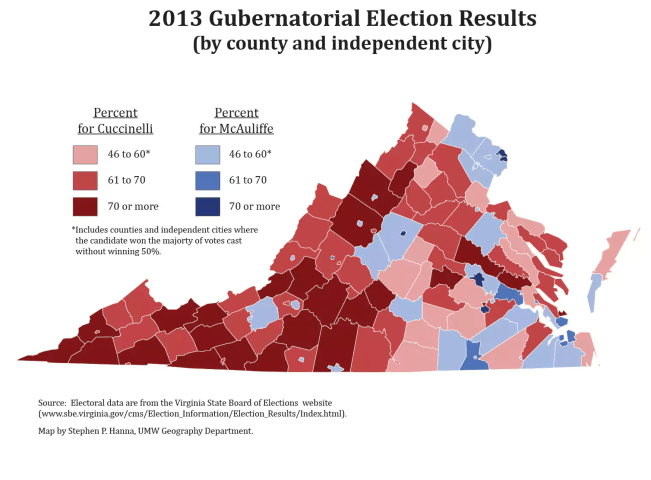
Interestingly enough, areas that tend to be more conservative had higher pregnancy rates than their more progressive counterparts. Generally, it is a conservative perspective that stresses the need for abstinence education and emphasizes the ‘benefits of marriage’ in intimate relationships. That being said, while some heavily conservative regions have intermediate rates of teen pregnancy, the overall trend shows that areas with higher concentrations of conservative voters deal with correspondingly high teen pregnancy rates.
Let me throw some statistics from the American Sexual Health Association at you. The Centers for Disease Control and Prevention (CDC) estimates that nearly 20 million new STIs occur every year in this country, with over 50% among young people aged 15–24. Even though young people account for more than half of these new STI cases, a recent survey shows that in past year, only about 12% of those between 15 and 24 were tested for STIs. Researchers estimate that at least 80% of sexually active people will have an HPV infection at some point in their lifetime. The vast majority of people with genital herpes—close to 90%—don’t know that they have the infection. Young people ages 15 to 24 accounted for 65% of positive chlamydia diagnoses and 50% of gonorrhea diagnoses in 2015. According to CDC, 1.1 million people in the US are living with HIV, and 1 in 7 of them don’t know it.
I include these figures because, should a Virginia school offer sexual education, the only required STI/STD education pertains to HIV. While including other STIs and STDs in the curriculum is permitted, it is up to the individual counties and schools to make that decision. With youth STI rates on the rise—going largely unaddressed—should the Code of Virginia be updated to require the teaching of symptoms and treatments of these diseases? I think so. WebMd or TeensHealth can only do so much, and are typically referenced when it’s too late to take preventative measures. Of course, including necessary STI awareness would also ask schools to expand their education past basic abstinence.
In summary, the Code of Virginia attempts to cater to progressive audiences by making some semblance of a requirement for sexual education, but as it was constructed with a heavily conservative bias, it ultimately allows state guidelines to be ignored completely. The problem is, sexual education should not exist in the realm of politics. It’s unrealistic and unsafe to maintain decade old policies founded in partisan politics as Virginia and the rest of the U.S. continues to evolve.
So, what can we do? Well, there’s currently a bill called HB159 that, according to the text, “requires each local school board to implement a comprehensive, sequential family life education curriculum in grades kindergarten through 12 that is consistent with the family life education Standards of Learning or curriculum guidelines developed by the Board of Education and removes from such standards and guidelines the requirement for instruction in the benefits, challenges, responsibilities, and value of marriage for men, women, children, and communities; abstinence education; the value of postponing sexual activity; and the benefits of adoption as a positive choice in the event of an unwanted pregnancy”. How do we get it passed? Write to your delegate or senator. Nationally, we’re still a long way from adequate sexual education, but this is a necessary first step.
As a generation, we continue to face resistance from legislation and legislators that are firmly rooted in the past. As young people who are profoundly affected by the disregard for our health, we have the loudest and most effective voices to make change with. At the moment, we see youth movements making significant headway on the national stage addressing gun violence. These students are up against powerful entities such as the NRA and the GOP, yet still manage to hold their own in town halls and in congressional offices. We can take a note from these students. Young people can be more than just activists; they are change makers. To be effective, we have to start at local levels, where things truly affect us. Sexual education is a perfect example, for if presented in the meaningful way, it can make a lasting difference in the lives of many young people, not just in Virginia but throughout the U.S. However, if we want this reality, we have to be active. To modernize the Code of Virginia would be to take a step forward—a large one—in the right direction, one that could set the precedent for change across the rest of the U.S and beyond.
 Soapbox 360